
Simple Cash vs. Other Payment Methods
How Simple Cash compares to card payments, simple payment platforms, and bank transfers — structurally and practically.
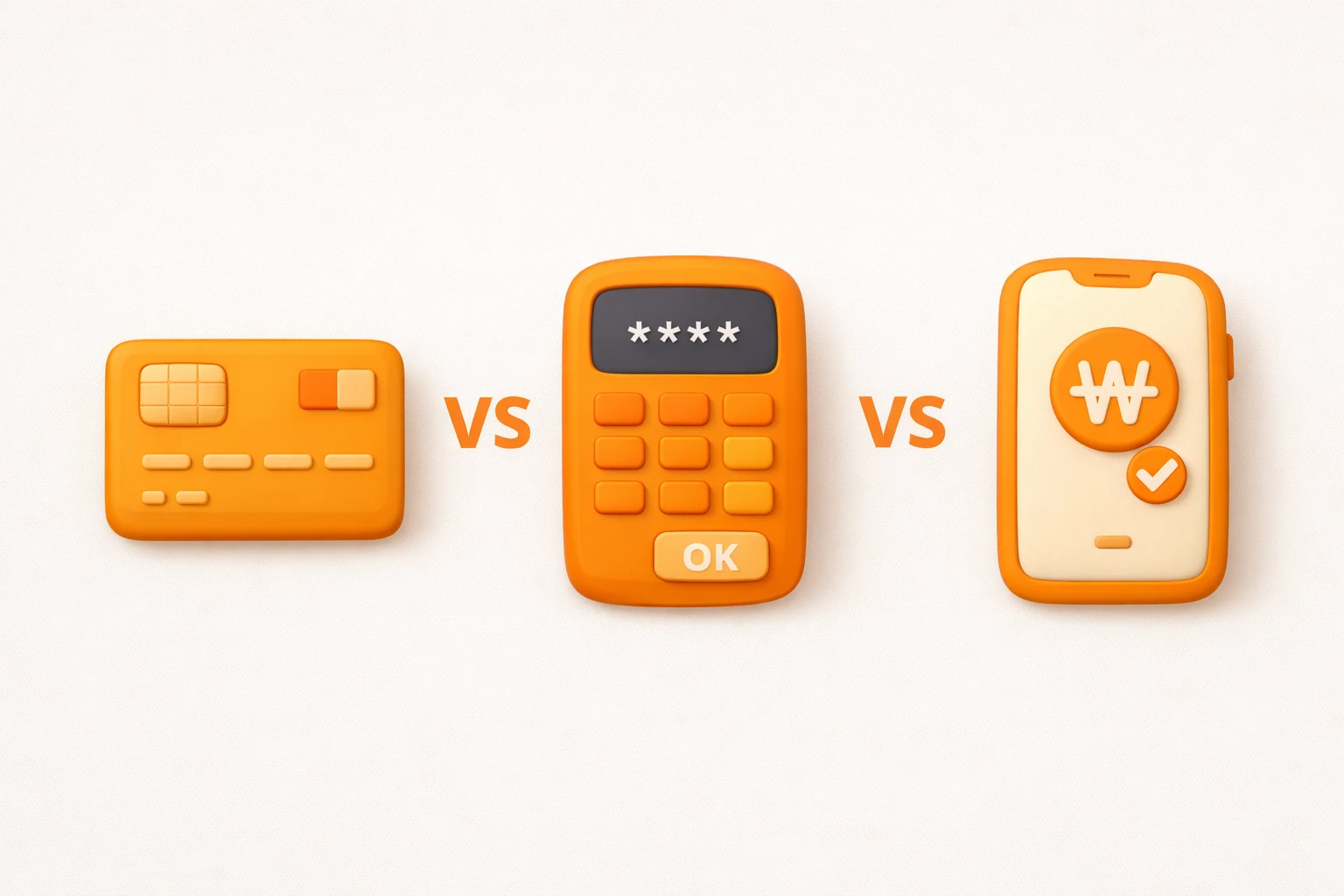
How do payment methods actually differ?
Online services today support a variety of payment methods. The most common are:
- Card payment
- Simple payment (e.g., Naver Pay, Kakao Pay)
- Bank transfer
- Simple Cash
Each has a distinct structure and set of trade-offs. This post compares Simple Cash against the other main payment methods to clarify what makes each one distinct.
Payment method overview
A quick look at how each method works:
| Payment method | How it works |
|---|---|
| Card payment | Card details submitted to card network for approval |
| Simple payment | Card or account stored in a third-party platform |
| Bank transfer | Direct transfer from a bank account |
| Simple Cash | Account registered once, then debited via lightweight authentication |
Simple Cash is best understood as a hybrid of account-based payments and the convenience of simple payment platforms. In practice, it often shows up alongside Pay-branded options at checkout.
Simple Cash vs. card payment
Card payments are the most widely used method, but they come with inherent friction:
- Card details must be entered at checkout
- Subject to credit limits
- Cards expire and can be lost or cancelled
Simple Cash sidesteps all of this. Because it debits directly from a bank account, no card is required at any point.
Simple Cash vs. simple payment platforms
Simple payment platforms like Naver Pay or Kakao Pay are convenient. Their approach:
- Store payment credentials on the platform
- Allow quick authentication for repeat purchases
The tradeoff is platform dependency — your users' payment experience is tied to a third-party service and its policies.
Simple Cash is different: it lets you implement account-based payments within your own service, without routing through an external platform.
Simple Cash vs. bank transfer
Standard bank transfer requires:
- Selecting a bank
- Entering account details
- Completing the transfer
Simple Cash requires account registration once, then only lightweight authentication for every subsequent payment. It's structurally the same as a bank transfer but with significantly less friction at checkout.
PG vs. simple payment vs. Simple Cash
| PG payment | Simple payment | Simple Cash | |
|---|---|---|---|
| Payment method | Card-centric | Platform-based | Account-based |
| Structure | PG → card network | Platform → PG | API → bank |
| Platform dependency | PG provider | Third-party platform | Relatively independent |
Choosing payment methods for your service
Production services rarely offer just one payment method. A typical configuration looks like:
- Card payment (via PG)
- Simple payment
- Simple Cash
Offering multiple options means users can pay the way they prefer, which improves overall payment completion rates.
Online payment infrastructure comes in several distinct shapes:
- PG payment: Card-based processing through a payment gateway
- Simple payment: Platform-mediated authentication against stored credentials
- Simple Cash: Direct account debit with lightweight authentication
Because each method has a different structure and trade-off profile, the right combination depends on your service's specific needs. For services with recurring payments — subscriptions, platforms, marketplace transactions — adding an account-based option like Simple Cash can meaningfully expand the range of users you can serve.

Need technical support?
Code Samples
HectoFinancial GitHub