
Cash Receipt Tax Calculation: A Complete Guide
From mixed taxation to rounding rules — everything you need to know about cash receipt amount calculations.
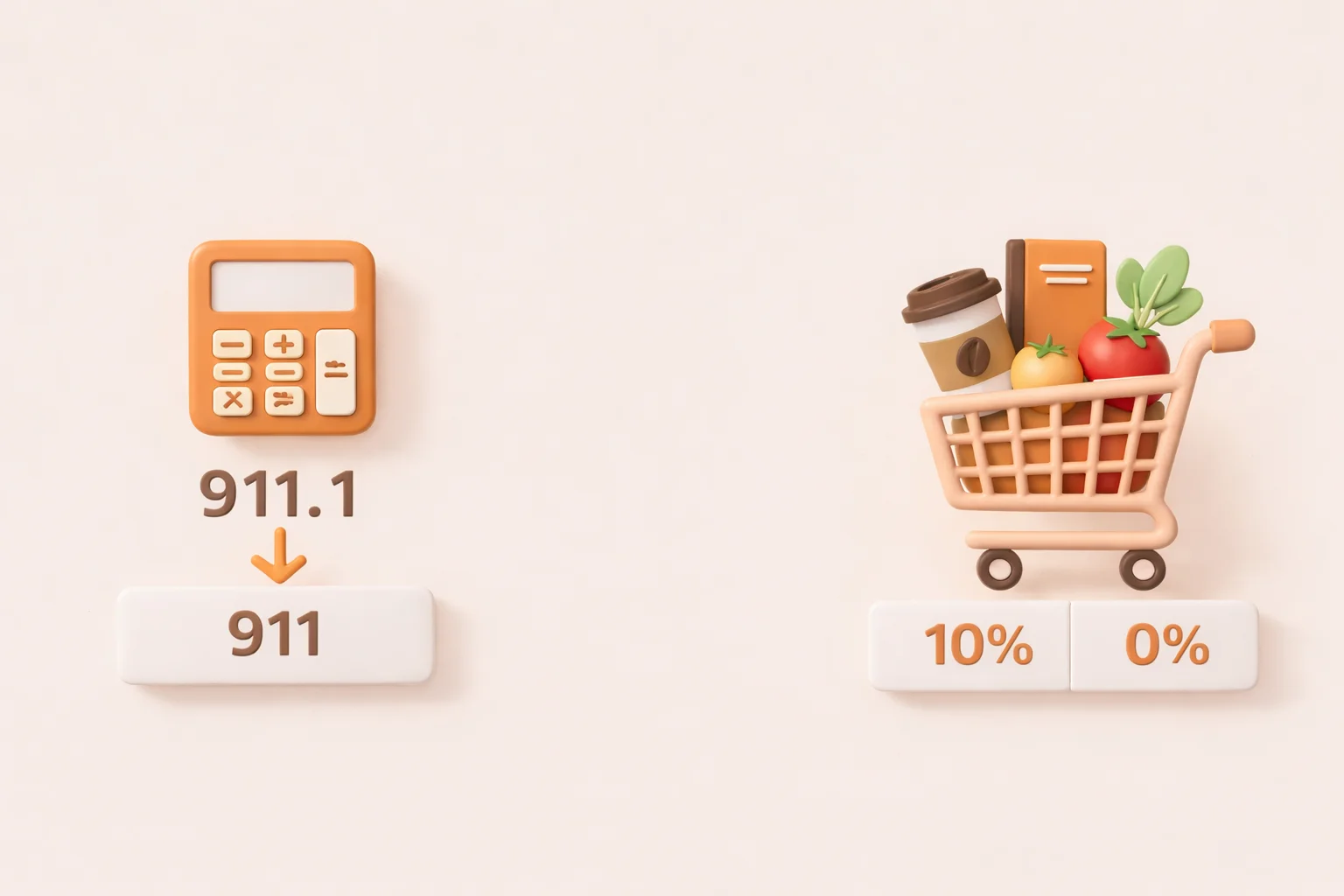
How Cash Receipt Amounts Are Structured
The amount displayed on a cash receipt breaks down into two components:
| Field | Description |
|---|---|
| Supply Value | The base price of the goods or service |
| VAT (Value Added Tax) | 10% of the supply value |
The formula: Total = Supply Value + VAT
Developer Note
What Is Mixed Taxation?
Mixed taxation applies when a single cart contains both taxable items (e.g., coffee) and tax-exempt items (e.g., books, unprocessed agricultural products).
| Type | Examples | VAT Applied | Notes |
|---|---|---|---|
| Taxable | Manufactured goods, processed foods | YES (10%) | Most general merchandise |
| Tax-Exempt | Books, water, agricultural produce | NO (0%) | No VAT at all |
Here's a worked example. Customer purchases a taxable item for KRW 11,000 (VAT-inclusive) and a tax-exempt item for KRW 5,000:
| Line Item | Amount |
|---|---|
| Tax-exempt supply value | KRW 5,000 |
| Taxable supply value | KRW 10,000 |
| VAT | KRW 1,000 |
| Total payment | KRW 16,000 |
Rounding Rules
Tax calculations often produce fractional amounts — for example, KRW 10.9. The NTS cash receipt standard uses floor rounding (truncation) as the default.
- Rule: Drop everything below the ones digit. Only whole Korean Won amounts are recognized.
- Why: Prevents tiny rounding discrepancies, and ensures consumers aren't charged sub-won tax amounts.
Example with a supply value of KRW 9,111:
| Line Item | Amount |
|---|---|
| Theoretical VAT | KRW 911.1 |
| Actual issued VAT | KRW 911 (KRW 0.1 truncated) |
| Final total | KRW 10,022 |
Easy to Miss
- Calculation order matters: Always derive the taxable supply value first using
(total - exempt amount) / 1.1, then truncate the result before computing VAT. Reversing the order introduces off-by-one errors that break data consistency.
For the full parameter-level breakdown of amount calculation rules, check the cash receipt documentation.

Need technical support?
Code Samples
HectoFinancial GitHub